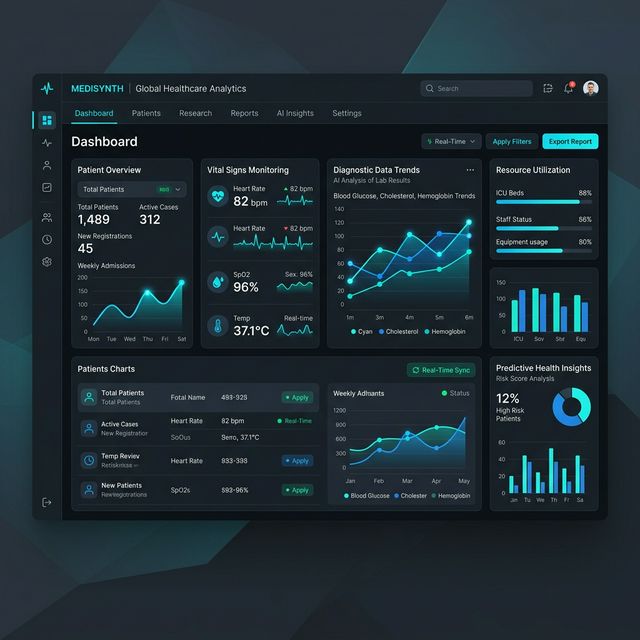

As health systems face unprecedented administrative strain, the transition from manual processing to autonomous intelligence is no longer optional—it is the bedrock of financial sustainability.
The Revenue Cycle Management (RCM) lifecycle has historically been defined by friction. From patient registration to final claim adjudication, the process is laden with manual data entry, human error, and a constant tug-of-war between providers and payers. However, we are witnessing a paradigm shift.
The Shift to True Autonomy
Current "automated" systems are often just series of robotic process automation (RPA) scripts—brittle rules that break when encountering a non-standard claim. True autonomy, powered by Large Language Models (LLMs) and predictive neural networks, doesn't just follow rules; it understands clinical context.
bolt Key Transformational Pillars
-
Predictive Denials Prevention: AI models analyze historical payer behavior to flag potential denials before a claim is even submitted.
-
Clinical Semantic Mapping: Automatically translating complex physician notes into ICD-10 codes with 99.8% precision.
-
Autonomous Payer Communication: AI agents that handle status inquiries and simple appeals via API or secure portals without human intervention.
“The future of RCM is not a faster human workflow; it is an invisible one.
Orchestrating AI Across the Revenue Cycle
Consider the sheer volume of manual interventions typically required for a complex pre-authorization. A transition toward autonomous workflows shifts the focus from manual follow-ups to executing flawless initial submissions. With multi-agent architectures, specialized intelligent agents read EMR data, compare it against global payer policies in real-time, and format the perfect claim instantly.
These intelligent clinical workforces do not sleep. They continuously learn from changing payer rules, dynamically updating their internal algorithms so that human administrators are never caught off-guard by updated ICD-10 guidelines or payer-specific edge cases.
Unlocking Strategic Financial Leverage
Beyond immediate operational efficiency, autonomous RCM unlocks massive financial leverage. The drastic reduction in A/R days transforms cash flow dynamics. Health systems can rely on predictive denial modeling which fundamentally eliminates surprise bad debts and significantly reduces labor costs tied to clinical appeals.
The Tulu AI Platform is already orchestrating this reality across integrated delivery networks globally. The question for clinical operations leaders is no longer whether autonomous AI will disrupt RCM, but how quickly they can weave this intelligence into their organization's DNA to serve more patients better.